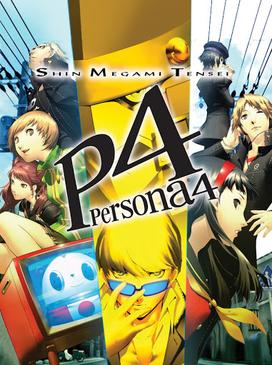
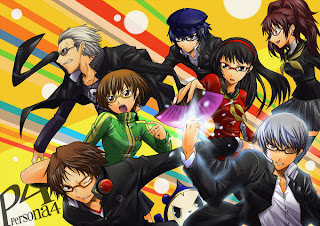
Shin Megami Tensei: Persona 4, originally released in Japan as simply
Persona 4 (ペルソナ4 Perusona Fō), is a role-playing video game developed and published by Atlus for Sony's PlayStation 2, and chronologically the fifth installment in the
Shin Megami Tensei: Persona series.
Persona 4
was released in Japan in July 2008, North America in December 2008, and
Europe in March 2009. It features a weather forecast system with events
happening on foggy days to replace the moon phase system implemented in
the previous games.
Instead of the city locales of previous games in the series,
Persona 4 takes place in a fictional Japanese countryside and is indirectly related to both
Shin Megami Tensei: Persona 3 (in terms of gameplay, story and production) and the
Persona 2
duology (in terms of Shadow selves and confronting them to awaken
Persona). The player-named main protagonist is a high-school student who
moved into the countryside from the city for a year. During his
year-long stay, he becomes involved in investigating mysterious murders
while harnessing the power of summoning Persona.
The release of the game in Japan was also accompanied with retail
merchandise revolving around the game's theme such as character costumes
and accessories. The North American package of the game was released
with a CD with selected music from the game, and, unlike
Persona 3, the European package also contained a soundtrack CD. The music was composed by Shōji Meguro,
with vocals by Shihoko Hirata who sang the theme song "Pursuing My True
Self". The game was positively received by critics, and it continues to
be promoted by Atlus through releases in other media such as adaptation
in manga and anime, followed by an enhanced remake, a fighting game sequel, and side stories in the forms of a manga and light novel.
Gameplay
Like its predecessor,
Persona 3, the gameplay of
Persona 4 alternates between that of a traditional role-playing video game and of a simulation game. The protagonist of
Persona 4 is a teenage boy, named and controlled by the player.
The game takes place over the course of a traditional Japanese school year.
Outside of key events, the protagonist attends school, and can interact
with other students and characters, spend time at part-time jobs to
earn money, or engage in other activities.
The player may also enter the "TV World", an alternate reality where the game's dungeon-crawling gameplay occurs.
Each day in
Persona 4 is broken up into different periods of time, such as
After School or
Evening.
Certain activities are limited to certain times of day. In addition,
the ability to engage in certain activities is based on the day of the
week, or the weather.
By spending time with people, the protagonist forms "Social Links",
which are friendships the protagonist makes as the game progresses, each
represented by one of the Major Arcana.
When a Social Link is first formed, it starts at Rank 1, increasing
over time as the protagonist spends time with that person, until it
reaches MAX Rank,which is Rank 10. Social Links grant the player bonuses
when creating new Personas in the Velvet Room.
Social Links are also influenced by the protagonist's five attributes:
Understanding, Diligence, Courage, Knowledge and Expression, which can
be improved through various activities, such as part-time jobs and
sports teams. These attributes in turn may also affect the protagonist's
interaction in daily activities outside of Social Links.
Persona 4's timeline
is driven by the disappearance of characters from the real world into
the TV World, indicated through the "Midnight Channel". The one-week
weather forecast indicates the amount of time players have to rescue
people who have disappeared, in which foggy days mark the deadline of
the rescue mission.
The game ends
when the player fails to retrieve the missing person in time, and is
given the choice to return to one week before the fog appeared.
While in the TV World, the player explores randomly generated dungeons
in the field map; each dungeon is of a certain theme, based on the
victim that has been kidnapped.
Dungeons are divided into floors, each containing Shadows, enemies the
protagonist and his friends fight, and treasure chests, which contain
items or equipment.
Combat

Within the TV World, players fight against Shadows as they continue
towards the final floor where the missing person is located. The game
switches to a battle screen whenever the player comes in contact with a
Shadow in the field map, and the player may be given the initiative if
the player strikes the Shadow unnoticed.
The battle system is turn-based, bearing similarities to the
Press Turn system used in other
Shin Megami Tensei
games. Each character can perform a basic attack, use a special skill,
or use an item. The player can choose to directly control the actions of
all party members, or use the "Tactics" option to guide how they
perform in battle.
Offensive abilities cause certain types of damage, such as
"physical", "fire" or "almighty". Enemies the player encounters may have
a weakness to a certain type of attack. By exploiting an enemy's
weakness, it will be knocked down, and the attacker is given the
opportunity to act again.
If every enemy in a battle is knocked down, the player may initiate an
All-out Attack,
a powerful attack in which the player's party rushes the downed
enemies, removing weaker enemies and inflicting heavy damage on stronger
ones.
At the end of the battle, players are awarded with experience and
items, and may be given the chance to choose a new Persona to summon in
battle.